“Our Leaders of today need the philosophy of the past, paired with the science and technology of tomorrow”
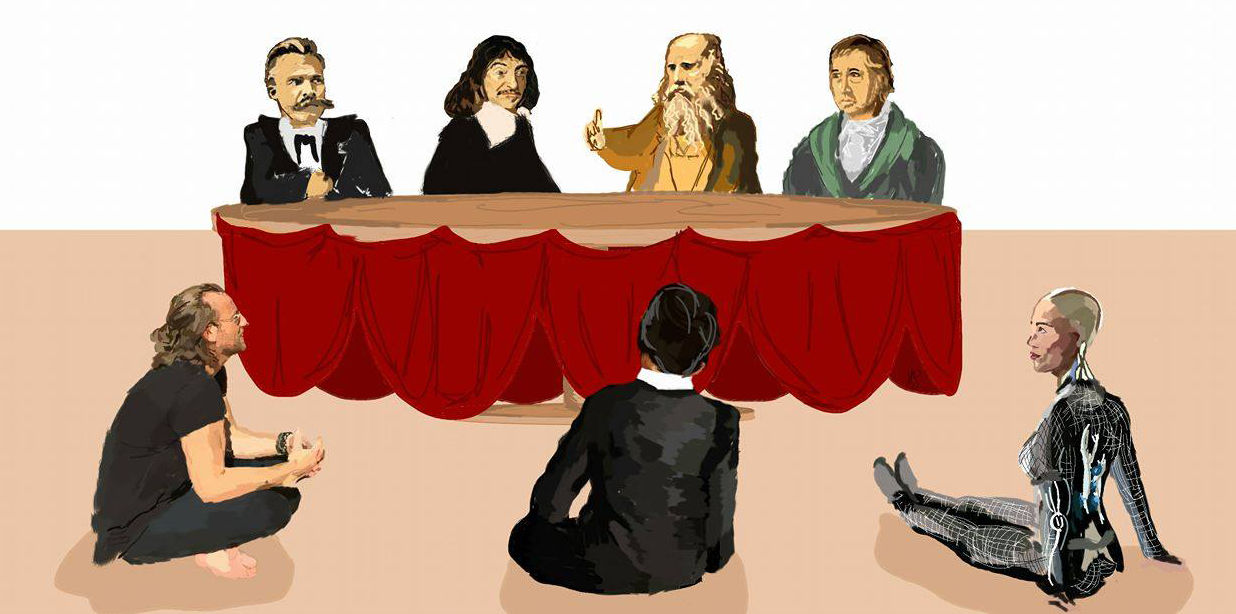
In order to understand what tomorrow will bring, we must study what has already come to pass and use the knowledge gleaned from history’s greatest thinkers to identify our current “blind spots” that those before us have already observed. The leaders and entrepreneurs of today will learn much by uniting their new-world viewpoints with the thoughts of the great philosophers from the past. Every thought has already been thought; we only have to try to project the thoughts of the greatest minds onto our modern society.
The German philosopher Georg Wilhelm Friedrich Hegel put it this way: important parts of ourselves can be found in history. In “The Phenomenology of Spirit” from 1807, he stated that every era can be considered a repository of a particular kind of wisdom. He said we must trace our way back in time to rescue things that have gone missing. For example, in Ancient Greece, people understood what a community can really be, which is something we have lost in recent times, but that is now returning as we become more interdependent and foster participatory cultures. Though the Middle Ages had a great deal of backwards thinking, in no other era can we learn so much about the importance of honor.
Progress is never linear: there is wisdom at every stage, and sometimes we lose a certain type of wisdom as we move forward. We have to rescue the ideas of the past to compensate for the blind spots of our present. Like Karl Jaspers, another German philosopher, proposed, we must keep a philosophical direction, even when we do not know the end goal.
With the collective wisdom of the ages, we can look forward to a promising future. The admired German philosopher Friedrich Nietzsche believed that “the future influences the present as much as the past.” Looking at the past, we can find problems a business can solve—but developing a plan to correct those problems is much more difficult. Understanding and being able to articulate your personal and business goals is often cited as a key to success, but understanding what you want to be, having a conscious mind, helps you make the right decisions now. To help you clarify your projected goals and figure out how to put the best plans into practice, here are seven and a half concepts to begin your transformation through philosophy:
1. Find Your Mentor
We start with a famous quote from Friedrich Nietzsche: “Whoever does not have a good father should procure one.” At age five, Nietzsche lost his father, yet the deceased man still had a profound impact on Nietzsche’s life; only the son of a preacher could challenge religion to the extent Nietzsche did.
Young people today place much importance in working for sexy brands like Google, Apple, and Facebook. The second crucial factor is, and this is important, they search for leaders and mentors in companies that really focus on helping their employees grow as people. These are often seen as father-figures in our careers (for entrepreneurs, the concept of “father” is interchangeable with “mentor”). Because mentors attract talent, which is a crucial asset in any company, leaders need to emphasize a positive relationship with their employees. In the fast-paced, complex world of business, progress and success are often achieved once executives seek a mentor, or even hire a coach or someone with other experiences and thoughts to engage in business sparring.
2. Accept Chaos
Whether you call it “creative disruption” or some other term, you know that progress is messy. The world and its markets progress by swinging from one extreme to another and overcompensating for previous mistakes, and some pundits suggest that three such dramatic shifts must occur before you can find the right balance on any subject. This dialectic dates all the way back to the Ancient Greek philosopher Plato.
Sometimes our setbacks and other issues lead us to something that catapults us into new thoughts, something truly original and better than ever. Again, we turn to Friedrich Nietzsche. In his 1883 novel “Thus Spoke Zarathustra: A Book for All and None,” he advanced his concept of “ubermensch” and wrote of it, “I tell you: one must still have chaos in oneself to be able to give birth to a dancing star.” The correlation between creativity, inner drive, and a bit of craziness is found particularly in entrepreneurship, but many larger corporations still need to adapt to this mentality as a basis for progress.
Recently, we have seen established industries pitting lawyers against young disruptors in order to keep the old and maintain the status quo. Chaos feeds creativity and grows business. Leaving everything old behind so as to create something new can be a disorganized, challenging journey. Whether the invention of the car, the creation of Napster (which paved the way to Spotify and Apple), the recent progress of Uber and AirBnB, or even the challenges of various FinTec and currency approaches (e.g. BitCoins), you can see how the changing market is always in a chaotic state.
3. Master the Art of Communication
The Austrian-British philosopher Ludwig Wittgenstein was confident he had created a masterpiece when he wrote his succinct book that addressed the relationship between language and reality; he thought he had produced the last book that ever needed to be written on the subject (though later in life he stumbled upon some new discoveries).
Obsessed with the difficulties of language, Wittgenstein wanted to find clarifications for some of the muddles we get into with words. Language is not only verbal pictures, but a tool we use to execute different patterns of intention. Wittgenstein offers important insight into how human beings can successfully share ideas with one another. Our basis of persuasive communication traces all the way back to the invention of Rhetoric: getting people to agree with you. Aristotle pointed out that one might recognize people’s fears and discover the emotional side of an issue—like whether someone’s pride is on the line—and from that knowledge one could convey the information in a way that will make the other person listen. Conveying a point also requires the art of appealing to your audience; attention spans are short (recent studies suggest that humans have attention spans shorter than that of goldfish – link…), which means you have to find a clever, amusing, or interesting way to relay ideas. Illustrations and examples can make your communication come alive to your listeners.
Both Wittgenstein and Aristotle address basic points to reflect on, which we often forget in our hectic lives of “just doing.” The frustration of many organizations today in regards to communication shows we are approaching the problem incorrectly. We can learn a lot by probing the art of communication, and we can start by delving into what Aristotle and Wittgenstein say on the matter.
4. “Bodenständigkeit” & “Authenzitität”
The complexity of language is reflected in the work of German philosopher Martin Heidegger. He worked with words such as “Seinsvergessenheit,” “Bodenständigkeit,” and “Wesensverfassung,” yet he points out crucial ideas we can learn from today. He was often viewed as incomprehensible, but was still a deeply valued philosopher who wanted us to lead more authentic lives. When we rise above our constraints, we can leave “Uneigentlichkeit” (inauthenticity) and embrace “Eigentlichkeit” (authenticity).
His concept of leading “my own” life, in the sense of it being “owned by me,” shows us how to stop living for “THEM,” the people around us and the expectations of our culture. Only when we stop worrying too much about what others think can we give up the “lion’s face” we use to try to impress others—often those who never even liked us in the first place. Heidegger tackled the idea of “Bodenständigkeit” (“rootedness”), which is about keeping our feet on the ground and returning to our roots. Delusions of grandeur caused by a fast change in our environment can lead us to lose touch with reality, particularly when money and success are involved. The French philosopher Michel de Montaigne probably has the most fitting quote to encompass this reality: “On the highest throne in the world, we are still seated upon our asses.”
We talk about authenticity in leadership all the time. Articles are written on the topic on a daily basis, but we still struggle to grasp and apply these concepts. Authenticity is closely related to trusting oneself and to finding one’s own meaning and foundation. We can begin our search for answers within the work of those who have already made great headway in uncovering the truth.
5. Slice the Elephant: Simplicity
French mathematician, scientist, and philosopher René Descartes taught us to divide large problems into small sections—bite-sized, as it were—by breaking down the question through what he called “the method of doubt.” Descartes’ method is also known as “hyperbolic doubt” and includes these rules:
– Accept information as true only when it is indubitable.
– Divide every question into smaller, manageable parts.
– Begin with the simplest issues and ascend in order to the most complex.
– Review frequently enough to retain the whole argument at all times.
This quasi-mathematical procedure to achieve knowledge is typical of a rationalistic approach to epistemology. The point of the method is to reduce complexity by removing small problems one by one. This problem-solving technique can be just as efficient in reaching success and happiness. There is no one solution for happiness nor a single definition of success, because there is no end state. If you are struggling to define success or to identify what makes you happy, start with the opposite; it is much easier to pinpoint what makes you unhappy or what holds you back. Therefore, start by getting rid of one thing at a time, solving problems piece by piece. In today’s complex world, success is often an outcome of letting go of things that hold you back or slow you down, because when you let go everything will fall into place afterwards.
6. Your Friend, the Enemy
Going with the flow can be helpful, but philosophy teaches us the importance of having different viewpoints. We return to Hegel, who pointed out that we can learn from our enemies and that we can find an advantage in studying ideas we dislike. Hegel was a great believer in learning from his intellectual enemies, from the points of view that he disagreed with or that were alien to him. What we should figure out is the underlying ideas or hidden meanings in the outlooks dissimilar from ours. We must anchor our agendas beyond our own egos, and look beyond our own noses for different answers and different viewpoints.
This mindset enables you to learn not only from your own failures but from the possibilities in competitors, in opposing viewpoints, and even in other cultures. Too often, our pride stands in our way. Like Hegel teaches us, adopting new strategies and thinking from new angles can be our greatest strength!
7. When the Going Gets Tough…
In Athens during the 3rd Century BC, Zeno of Citium founded Stoicism, a school of Hellenistic philosophy, which later included great philosophers such as Seneca the Younger and the Roman emperor Marcus Aurelius. The wisdom of these ancients provides us with many solutions to our cope with our difficulties and shortcomings.
During times of panic or when we want to surrender, for instance, their enduring philosophies supply us with perspective. Life and business are anything but easy. Every time you hear about “the fast way,” you know to stay away; most likely, the only one to benefit (at least financially) from such schemes is the one selling the ideas. Instead of taking shortcuts, especially when things get hard, we have to follow the mantra, “When the going gets tough, the tough get going.” There will be hard times, yes, but you will get through them. Seneca stated that “Relying on hope will only lift you further up before you eventually fall down.” He also said, “And if you cannot see any solution, suicide is always an option.” This, of course, reminds us that our problems can always be worse. One way to apply the concept Seneca presents is to put ourselves in situations where we can easily see its truth: twice a year, practice worse-case scenarios. This exercise will help you manage all kinds of difficult situations you might face later on. Obviously the experiences will prove useful in our unpredictable future, but it also demonstrates that your current problems are not as bad as they could be.
7.5. … You Get Stronger
There is probably no Nietzsche quote more often cited (and misquoted) than, “Out of life’s school of war: What does not kill me makes me stronger.” Although the younger generation sings these words as the lyrics of Kelly Clarkson, the concept is actually rooted in Nietzsche’s philosophy and can be applied easily to business. Leaders learn from their mistakes. Often, the bigger the blunder, the more experience one gains.
Getting knocked down by a competitor or matching your skills against business partners will focus your mind on revenge—in a constructive way. Failure and loss have other benefits: they can lead to valuable soul-searching and to future victories. Another great German philosopher, Arthur Schopenhauer, who was deeply influenced by Buddhist thought, introduced the term “Wille zum Leben” (“the will-to-have-life”) to name the powerful force within every human that encourages us to cling to existence, to push forward, and to always look for our own advantage. Marcus Aurelius said, “We are each of us stronger than we think,” and for entrepreneurs and challenged leaders, we need to immerse ourselves in such thoughts from the past to help us forge our way into a better future.
Just like the progress made in the fields of science and technology, the time has now come to move the art of philosophy into the 21st century and project the thoughts of the admired thinkers on to our new world – a task for our Leaders and Entrepreneurs in the years to come.
 Norwegian-born occasional tech-investor based in Frankfurt, Germany, Anders Indset is founding partner of Frankfurt International Alliance (FIA) and author of Wild Knowledge: Outthink the Revolution (2017).